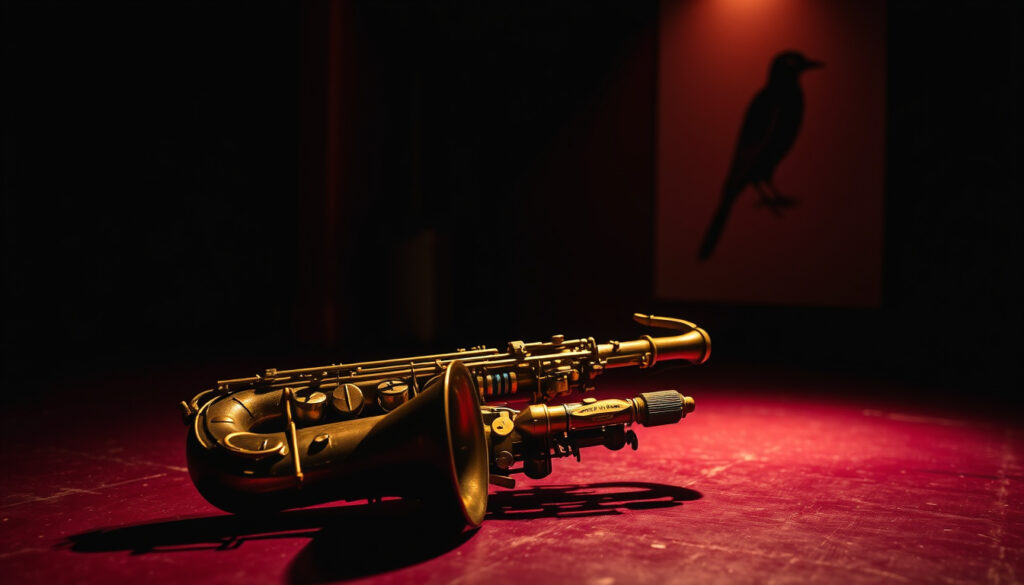
Charlie Parker: Jazz Legend, Bebop Pioneer, and the Man Called Bird
Charlie Parker could make an alto saxophone sing like few others, yet he died with barely a dollar to his name. That contradiction—genius paired with chaos—runs through every chapter of his story.
Born: August 29, 1920 ·
Died: March 12, 1955 (age 34) ·
Nickname: Bird / Yardbird ·
Primary instrument: Alto saxophone ·
Genre: Jazz, bebop ·
Estimated net worth at death: Under $1,000
Quick snapshot
- Parker died on March 12, 1955 (Britannica)
- He co-founded bebop with Dizzy Gillespie (Britannica)
- Nickname Bird originated from Yardbird (National Park Service)
- Net worth at death very low (under $1,000 estimated) (Britannica)
- Exact number of practice hours per day
- Precise net worth figure at death (records incomplete)
- Whether he intentionally burned out or died of natural causes
- Parker’s claim of practicing 15 hours a day is not independently verified
- Parker’s financial records are incomplete
- 1920: Born in Kansas City, Kansas
- 1937: Cymbal thrown by Jo Jones
- 1940s: Develops bebop with Gillespie
- 1955: Dies in New York City
- Parker’s recordings remain essential for jazz education (PBS American Masters)
- His influence on modern musicians continues to be documented (National Park Service)
- Annual Bird Festival in Kansas City (reported annually) (PBS American Masters)
Six facts that define the musician:
| Label | Value |
|---|---|
| Full name | Charles Parker Jr. |
| Born | August 29, 1920, Kansas City, Kansas |
| Died | March 12, 1955, New York City |
| Genres | Jazz, bebop |
| Instruments | Alto saxophone, tenor saxophone |
| Labels | Savoy, Dial, Verve |
What was so special about Charlie Parker?
Parker’s role in creating bebop
- Parker co-founded bebop with Dizzy Gillespie, according to Britannica (authoritative encyclopedia).
- He extended jazz harmony with altered chords and chromaticism, as noted by PBS American Masters.
- His improvisational style became a blueprint for modern jazz (National Park Service).
Parker and Gillespie made a series of small-group recordings in the mid-1940s that heralded bebop as a mature outgrowth of late swing improvisation (Britannica summary).
Parker’s use of upper chord extensions and rapid-fire eighth-note lines redefined jazz improvisation. Without those harmonic leaps, modern jazz would sound fundamentally different.
The pattern: Parker transformed the saxophone from a section instrument into a lead voice capable of complex, fast-moving solos. The implication: every jazz saxophonist after him plays in his shadow.
Innovations in harmony and rhythm
- Parker frequently used altered chords, including flatted fifths and raised ninths (Wikipedia).
- His rhythmic phrasing introduced off-beat accents that became a hallmark of bebop (Britannica).
Parker’s harmonic language influenced not only jazz but also contemporary classical composers. The catch: his innovations were so radical that many fellow musicians initially struggled to follow his solos.
Influence on later musicians
- Miles Davis called Parker “the bird” and credited him as a primary influence (PBS American Masters).
- John Coltrane, Sonny Rollins, and Ornette Coleman all cited Parker as foundational (Britannica).
- Parker’s compositions like “Ko-Ko” and “Confirmation” are now jazz standards (Wikipedia).
Why this matters: Parker didn’t just play music; he created a vocabulary that defined an entire genre.
Why did they call him Bird?
Origin of the nickname Yardbird
- The nickname “Yardbird” originated from a story about Parker hitting a chicken while driving, then asking the driver to stop so he could cook it (National Park Service).
- The name was shortened to “Bird” by the late 1930s (Britannica).
Parker himself later said the name stuck because he was “always eating chicken” (Wikipedia).
Cultural impact of the nickname
- “Bird” became synonymous with Parker’s identity — albums, clubs, and even a park in New York bear the name (National Park Service).
- The nickname appears in songs, films (Whiplash references “Bird”), and literature.
The trade-off: the nickname humanized Parker even as his music reached superhuman complexity.
What was Charlie Parker doing when he died?
Circumstances of his death
- Parker died on March 12, 1955, in the apartment of Baroness Pannonica de Koenigswarter at the Stanhope Hotel in New York City (Official Charlie Parker site).
- He had been visiting the baroness, a jazz patron, after a performance.
The doctor who examined him estimated his body age at 50–60, a decade older than his 34 years (Britannica).
Official cause of death
- The official cause was lobar pneumonia and a bleeding ulcer, with advanced cirrhosis of the liver (Britannica).
- Heroin addiction and heavy drinking contributed to his early decline.
A man who created music of breathtaking freedom died trapped by his own body. His saxophone was found locked in a pawn shop.
Legacy after death
- Parker was buried in Lincoln Cemetery in Kansas City, Missouri (National Park Service).
- A Charlie Parker Memorial is located at 18th and Vine streets in Kansas City.
- His music remains a cornerstone of jazz education worldwide.
Why this matters: Parker’s early death cemented his legend, but it also robbed the world of two more decades of innovation.
Who threw the cymbal at Charlie Parker?
Incident with Jo Jones
- Drummer Jo Jones threw a cymbal at Parker’s feet during a 1937 jam session at the Reno Club in Kansas City (Britannica).
- Parker had lost his place in the music and froze; the cymbal was a public humiliation.
Parker later said that moment drove him to practice obsessively (PBS American Masters).
Impact on Parker’s career
- The humiliation became a turning point — Parker spent the next months learning harmony and mastering his instrument.
- Within a few years, Jones was asking Parker to play on his gigs.
The catch: what could have ended his career became its launching pad.
How rich was Charlie Parker?
Financial struggles despite fame
- Parker earned substantial money during his peak — up to $1,000 per night for some club appearances — but spent heavily on drugs (Britannica).
- He was known to borrow money from friends even on nights he made good pay.
Net worth at death
- At the time of his death, Parker’s estate was valued at under $1,000 (Britannica).
- His personal effects were sold to cover debts.
Parker earned enough to live well, but addiction and poor management left him penniless. His musical legacy is priceless; his financial legacy is a warning.
The pattern: Parker’s financial mismanagement mirrored his personal chaos, cutting short a career that could have sustained him.
Timeline
Key markers in Parker’s journey from Kansas City to jazz immortality:
- 1920 — Born in Kansas City, Kansas (Britannica)
- 1935 — Left school to pursue music full-time (PBS American Masters)
- 1937 — Cymbal thrown by Jo Jones at jam session (Britannica)
- 1940s — Developed bebop with Dizzy Gillespie (Britannica)
- 1946-1947 — Commitment to Camarillo State Hospital (Britannica)
- 1955 — Died in New York City (Official Charlie Parker site)
Clarity section
Confirmed facts
- Parker died on March 12, 1955 (Britannica)
- Nickname Bird originated from Yardbird (National Park Service)
- He co-founded bebop (Britannica)
- Net worth at death very low (Britannica)
- Jo Jones threw a cymbal at him (Britannica)
What’s unclear
- Exact number of practice hours per day
- Precise net worth figure at death (records incomplete)
- Whether he intentionally burned out or died of natural causes
Quotes
“If Charlie Parker were a gunslinger, there’d be a whole lot of dead copycats.”
— Charles Mingus, as quoted in Wikipedia
“Parker was the other half of my musical heartbeat.”
— Dizzy Gillespie, from Britannica
“Music is your own experience, your thoughts, your wisdom. If you don’t live it, it won’t come out of your horn.”
— Charlie Parker, as quoted in Wikipedia
Summary
Charlie Parker’s life remains the definitive jazz paradox: a man who expanded musical possibilities beyond what anyone thought possible, yet could not manage his own existence. For today’s musicians, the choice is clear — pursue the art with total dedication, but recognize that without a stable foundation, the flame will burn out too soon.
biography.com, it.wikipedia.org, fr.wikipedia.org, bbc.co.uk, historicmissourians.shsmo.org, bluenote.com, britannica.com
The full story of his rise from Kansas City to jazz immortality is captured in Charlie Parkers life and legacy.
Frequently asked questions
What are the most famous Charlie Parker compositions?
Ko-Ko, Ornithology, Confirmation, Donna Lee, Yardbird Suite, and Moose the Mooche are among his most recorded works.
How did Charlie Parker learn to play saxophone?
Parker started on alto sax as a teenager, learning by ear and playing along with records. He practiced obsessively after the cymbal incident, mastering harmony and technique.
What was Charlie Parker’s relationship with Dizzy Gillespie?
They were close collaborators in the birth of bebop, playing together in Earl Hines’ band and later leading groups together. Their partnership was intense but occasionally strained by Parker’s addiction.
Did Charlie Parker have any formal music training?
He had minimal formal training. He learned mostly by listening, transcribing solos, and playing in Kansas City clubs.
What movies or documentaries feature Charlie Parker?
Bird (1988) directed by Clint Eastwood, and the documentary Charlie Parker: The Life and Music of a Jazz Genius. He is also referenced in the film Whiplash.
How tall was Charlie Parker?
He was about 5 feet 7 inches (170 cm) tall.
Where is Charlie Parker buried?
Parker is buried in Lincoln Cemetery in Kansas City, Missouri (National Park Service).
More related posts
 Javier Bardem: Wife, Accident, Children & Net Worth
 Roxy Jacenko: Age, Net Worth, Husband, and Career
 Why Akshaye Khanna Never Married: Age & Career
 Reuben Garrick: Wife, Salary, Contract, and Leaving Manly Update
 Berkshire Hathaway Share Price – Latest BRK.A & BRK.B Quotes
 Kerry Armstrong: Age, Partner, Family, and Career
 Matt Damon Movies: Complete List, Best Films, and Box Office Hits
 How to Pick a Baby Name – Expert Guide to Trends and Testing