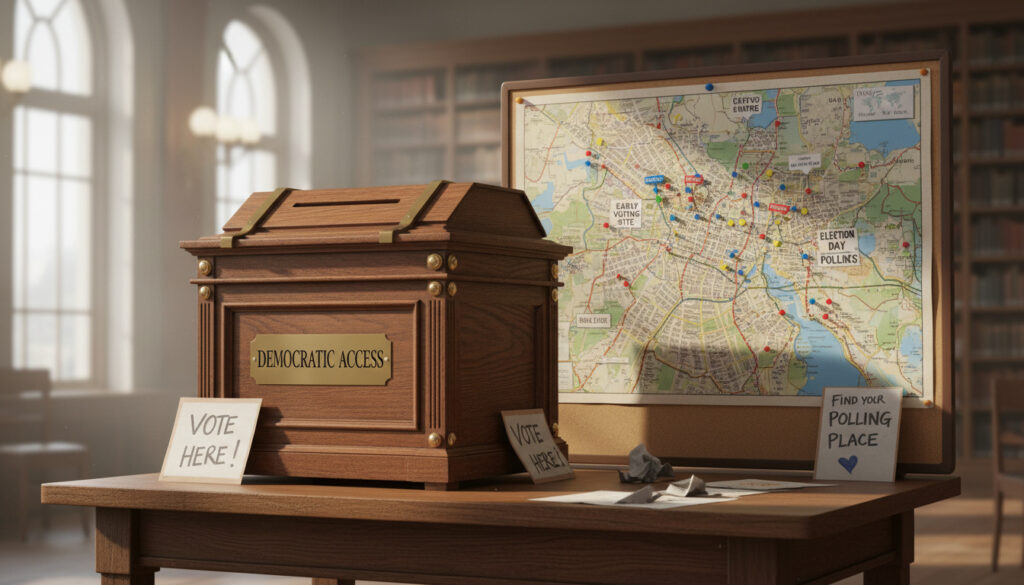
Where Can I Vote – Find Polling Places, Early Voting and Rules
Locating your designated voting site represents the critical first step toward casting a ballot in any U.S. election. Federal and state governments maintain separate but complementary systems to direct registered voters to assigned polling places, early voting centers, and secure ballot drop-off locations. Understanding which official tool to use—and what residential information you must provide—prevents logistical complications as election deadlines approach.
Every state administers its own election infrastructure under federal oversight, meaning specific hours, identification requirements, and location availability vary significantly by jurisdiction. While some voters must visit a single assigned precinct on Election Day, others utilize flexible early voting periods or mail-in options that remove the need to appear in person entirely. Official federal resources provide entry points to these state-specific systems.
Where Is My Polling Place?
Your assigned Election Day polling place depends on your residential address and precinct designation. State election offices maintain geographic lookup tools that translate street addresses into specific facility locations.
Assigned precinct locations specific to your residential address where in-person voting occurs during official Election Day hours.
Designated sites open before Election Day allowing in-person voting at flexible hours, often located at registrar offices or public buildings.
Absentee ballots sent through postal mail for registered voters who cannot visit physical polling locations on Election Day.
Authorized locations for submitting completed mail-in ballots without relying on postal service delivery timeframes.
Several patterns emerge when examining voting logistics across jurisdictions:
- Most states assign specific polling places based on residential address and precinct boundaries
- Early voting locations frequently differ from Election Day precinct sites and may include multiple county-wide options
- Photo identification requirements vary substantially by state statute, with some accepting digital licenses while others require physical cards
- Mail-in ballot receipt deadlines typically precede Election Day, contrasting with postmark rules in some jurisdictions
- Polling place locations can change between election cycles due to redistricting, facility availability, or accessibility upgrades
- Federal portals direct voters to state-specific lookup tools rather than maintaining universal databases
- Same-day registration remains unavailable in numerous jurisdictions, requiring advance preparation
The following comparison outlines standard characteristics across voting methods:
| Method | Availability | Typical Requirements | Primary Tool |
|---|---|---|---|
| Election Day Voting | First Tuesday after first Monday in November (federal elections) | Active registration; government-issued photo ID (varies by state) | vote.gov state links |
| Early In-Person Voting | Varies: 7-14 days preceding Election Day (state-specific) | Registration; same ID as Election Day | State Secretary of State portals |
| Mail-In/Absentee | Varies: 15-45 days before Election Day for requests | Approved application; ballot received by deadline | County registrar offices |
| Ballot Drop-Off | During early voting and Election Day (varies) | Official ballot envelope; sometimes ID verification | Designated county facilities |
| Curbside Voting | Election Day and early voting (where authorized) | Disability accommodation request | Precinct election judges |
| Provisional Ballots | Election Day when eligibility questioned | Affirmation of registration; ID in some states | Polling place officials |
Where Can I Vote Early?
Early voting expands accessibility by opening designated locations weeks before Election Day. These sites typically operate at county or parish registrar offices, though some jurisdictions utilize additional public facilities such as libraries or community centers.
Locating Early Voting Sites
State election offices publish early voting location lists approximately one month before elections. In Louisiana, for example, the Secretary of State maintains parish-specific directories showing sites such as courthouses, city halls, and annex buildings. Voters can access sample ballots and transportation assistance through community coalition resources.
Early voting venues change between election cycles. Contact your local parish or county registrar to confirm current sites, as online portals may not reflect last-minute venue modifications due to construction or weather events.
Early Voting Hours and Procedures
Operating hours for early voting typically extend beyond standard business times to accommodate working schedules. Louisiana’s 2024 Presidential General Election utilized an October 18-29 early voting period (excluding Sundays), with sites open 8:30 a.m. to 6:00 p.m. Identification requirements mirror Election Day standards, accepting driver’s licenses, military IDs, or other picture identification bearing the voter’s name and signature.
What Are Polling Hours and What Do I Need to Vote?
Understanding operational timeframes and documentation requirements prevents disqualification at the check-in table. While federal law mandates certain protections, states control specific logistical details.
Standard Polling Hours
Election Day polls traditionally open between 6:00 a.m. and 7:00 a.m. and close between 7:00 p.m. and 8:00 p.m., varying by state and time zone. Louisiana polls opened at 6:00 a.m. and closed at 8:00 p.m. during recent federal elections. Voters standing in line at closing time retain the right to cast ballots.
Identification Requirements
States impose varying documentation standards. According to voter rights organizations, acceptable forms typically include state driver’s licenses, special identification cards, military identification, or digital wallet credentials where authorized. Some jurisdictions permit voters without ID to sign affidavits, though this procedure varies by location.
Louisiana voters must present valid photo identification including a driver’s license, special ID card, military ID, or picture ID containing name and signature. Voters without acceptable identification may sign an affidavit, but specific requirements differ significantly across state lines—verify local rules before traveling to polls.
Mail-In and Drop-Off Voting Locations
Absentee voting provides alternatives for citizens unable to visit polling places physically. Success depends on understanding submission deadlines and authorized return methods.
Requesting and Submitting Mail Ballots
Mail-in ballot applications typically require submission 15 to 30 days before Election Day. In Louisiana’s 2024 cycle, voters had to request absentee ballots by November 1 at 4:30 p.m., with completed ballots received by November 4 at 4:30 p.m.—not merely postmarked by that date. Academic voter guides track these shifting deadlines.
Secure Drop-Off Procedures
Many jurisdictions authorize hand-delivery of completed mail ballots to registrar offices or designated drop boxes. This method eliminates postal service delays while maintaining chain-of-custody protocols. Voters must typically deliver ballots themselves or through authorized agents, depending on state law. For those who prefer to hand-deliver their ballot, you can find your nearest polling place at Flint and steel fire starting guide.
Mail-in ballots must typically be received by elections officials by specific deadlines—often the day before Election Day—rather than simply postmarked. Hand delivery to county registrar offices ensures compliance with receipt requirements and eliminates postal transit uncertainties.
When Are the Critical Dates for Voting?
Electoral calendars follow predictable sequences, though specific dates shift yearly. The following timeline reflects standard scheduling using 2024 federal elections as reference points.
- : In-person and mail registration typically closes 30 days before Election Day (October 7, 2024 reference)
- : States offering digital registration often extend this option approximately three weeks before Election Day (October 15, 2024 reference)
- : In-person early voting begins, typically two weeks before Election Day
- : Final day to request mail-in ballots, usually four days before Election Day
- : Completed absentee ballots must reach registrar offices (day before Election Day in some jurisdictions)
- : Federal Election Day, with polls open 12-14 hours depending on jurisdiction
- : Deadline for verifying provisional ballots cast during Election Day
What Rules Are Fixed and What Varies by State?
Voting logistics operate within a framework of federal mandates and state discretion, creating a patchwork of procedures that require localized verification.
| Established Standards | Variable by Jurisdiction |
|---|---|
| Election Day for federal offices occurs the first Tuesday after the first Monday in November | Specific polling hours (e.g., 6 a.m.–8 p.m. vs. 7 a.m.–7 p.m.) |
| All states must provide absentee voting options for military and overseas citizens (federal law) | Availability of no-excuse early voting or mail-in voting for domestic voters |
| Voter registration databases maintained at state level | Same-day voter registration availability |
| Secret ballot guarantee | Specific forms of acceptable photo identification |
| Accessibility requirements under federal disability law | Number and location of early voting sites |
| Prohibition on racial discrimination in voting (federal law) | Rules regarding ballot drop boxes and third-party ballot collection |
How Are Voting Locations Determined?
The United States utilizes decentralized election administration, placing authority for polling place selection at state and local levels. County and parish clerks identify facilities based on geographic population distribution, building accessibility, and budget constraints. Rural jurisdictions may consolidate precincts due to resource limitations, while urban areas typically maintain numerous neighborhood sites to prevent overcrowding.
Redistricting following census cycles alters precinct boundaries, potentially changing assigned polling locations for thousands of voters between election years. Local election commissions notify affected residents through mailers, though these notices occasionally arrive after early voting begins. Planning government interactions—whether finding Urgent Care Near Me – Hours, Costs, Vs ER Guide or confirming polling coordinates—requires verifying current local information.
What Do Election Officials Recommend?
Official guidance emphasizes preparation and verification. Federal resources direct voters toward state-specific tools rather than providing universal lookups, recognizing the complexity of 50 separate election codes.
The official U.S. government sites serve as primary polling place finders, early voting locators, mail-in ballot drop-off guides, and 2024 election resources, directing users to state-specific details. These sites provide eligibility checks for absentee, early, or Election Day voting, voter ID requirements, and polling station locations.
— usa.gov
State officials consistently advise voters to verify registration status and polling locations 30 days before elections, allowing time to correct administrative errors or address changes.
For current elections, check vote.gov or state sites as rules and dates change; Louisiana uses a “jungle primary” system where all candidates run together, with runoffs if no majority.
— Federal voting guidance
How Should I Prepare to Cast My Ballot?
Finalizing your voting plan requires confirming registration status, identifying your specific polling place or early voting center, and assembling required documentation. Check deadlines for mail-in ballot requests if avoiding in-person voting. Just as obtaining licenses requires navigating Book Driving Test Qld – Step-by-Step Booking Guide, participating in elections demands attention to procedural details and advance scheduling to ensure eligibility.
Frequently Asked Questions
What if my polling place changed since the last election?
Check your registration status online through your state’s election portal or call the county registrar. Redistricting and facility changes occasionally relocate polling sites between election cycles.
Can I vote at any polling place in my county?
Generally no—Election Day voting requires visiting your assigned precinct. However, early voting centers often allow any registered county resident to vote at any available location.
What happens if I moved recently?
Update your registration immediately with your new address. Some states permit address updates on Election Day at the new precinct; others require re-registration beforehand.
What if the lines are long at closing time?
Federal law guarantees that voters standing in line when polls close may remain until they cast ballots. Arrive early to avoid delays, but do not leave if the deadline passes while you wait.
Can I drop off my mail-in ballot at any polling place?
Typically no—mail ballots must be returned to designated registrar offices or secure drop boxes, not standard Election Day polling places. Verify authorized locations with your county clerk.
How do I vote if I need language assistance?
Federal law requires jurisdictions with significant non-English populations to provide bilingual ballots and interpreters. Contact your county election office to request language accommodation before Election Day.
What ID do I need if my driver’s license expired?
Requirements vary. Some states accept expired IDs within a specific timeframe; others do not. Check your state election website or contact the registrar to confirm acceptable alternatives.
Can someone else return my mail-in ballot?
State laws differ regarding ballot collection. Some jurisdictions permit family members or caregivers to deliver ballots; others restrict this practice to the voter alone. Verify local regulations to avoid disqualification.
More related posts
 What Are Prime Numbers? Definition, List, and How to Check
 Chris Cornell Cause of Death: Last Words, Sobriety, Estate
 Nelson Asofa-Solomona: Storm Exit, Boxing Debut & Bans
 Barbara Palvin: Endometriosis, Relationships, and Career
 Central Coast Mariners FC: APL Takeover After Titles
 Kim Young-Kwang: Age, Height, Marriage, Dramas, and Latest News
 War Machine 2026: Hit or Flop? Plot, Cast, Reviews
 Hand Car Wash Near Me: Ireland’s Best Options & Comparisons