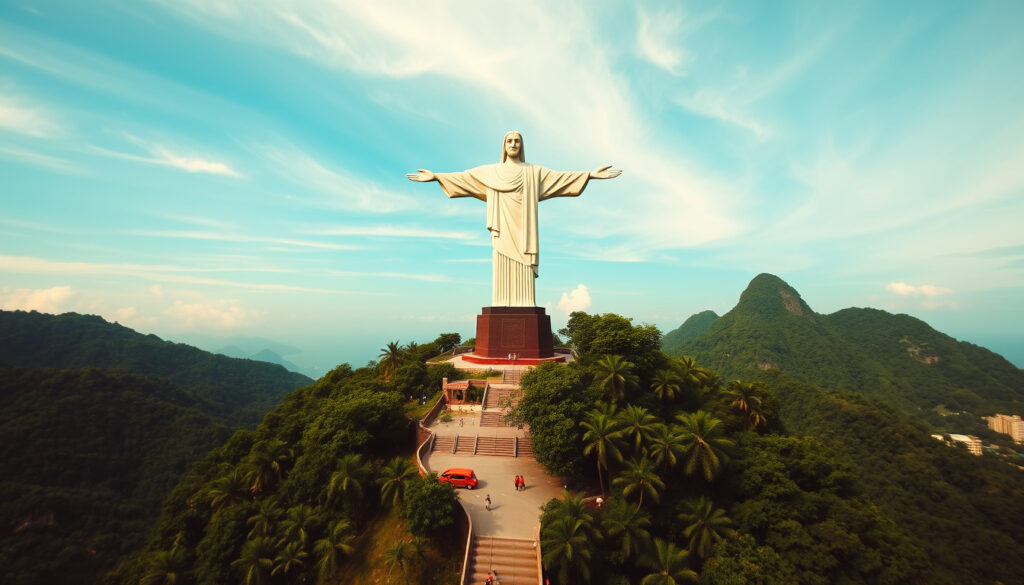
Christ the Redeemer: Facts, History, and Visitor Guide
There’s something about a 98-foot statue standing on a mountaintop that makes you stop and look up. Completed in 1931 after nine years of construction, Christ the Redeemer is more than a religious symbol—it’s a blend of French artistry and Brazilian engineering set against the skyline of Rio de Janeiro.
Height (statue only): 98 feet (30 meters) ·
Arm span: 92 feet (28 meters) ·
Construction period: 1922–1931 (9 years) ·
Location: Mount Corcovado, Rio de Janeiro, Brazil ·
Material: Reinforced concrete and soapstone ·
Style: Art Deco
Quick snapshot
- Completed in 1931 (Encyclopaedia Britannica (reference work))
- Designed by French sculptor Paul Landowski (History Hit (history publication))
- Weighs 635 metric tons (History Hit (history publication))
- Total cost in modern currency is not precisely known (Go Ahead Tours (travel operator))
- Exact number of annual visitors varies by source (around 2 million) (Go Ahead Tours (travel operator))
- Exact number of lightning strikes and damage extent not fully documented (Go Ahead Tours (travel operator))
- 1850: First proposal for a religious monument on Corcovado (Encyclopaedia Britannica (reference work))
- 2007: Named one of the New7Wonders of the World (History Hit (history publication))
- Ongoing conservation efforts after lightning strikes (CNN (news outlet))
- Visitor access upgrades to the observation deck (CNN (news outlet))
Five key data points, one pattern: each measure reinforces the monument’s sheer scale and the cross-continental collaboration behind it.
| Label | Value |
|---|---|
| Official name | Cristo Redentor |
| Sculptor | Paul Landowski (French) |
| Engineer | Heitor da Silva Costa (Brazilian) |
| Inauguration date | October 12, 1931 |
| Construction cost | Approx. US$250,000 (1931) |
| Total weight | 635 metric tons |
| Statue height | 98 feet (30 m) |
| Arm span | 92 feet (28 m) |
| Material | Reinforced concrete and soapstone |
| World Heritage status | Part of UNESCO Carioca Landscapes (2012) |
Why is Christ the Redeemer so famous?
Symbol of peace and faith
- The statue symbolizes peace and is a global icon of Christianity (History Hit (history publication)).
- Its open-armed pose has come to represent Brazilian hospitality and warmth.
Iconic location on Mount Corcovado
- Perched 2,310 feet (704 m) above Rio, the statue is visible from nearly every part of the city (Encyclopaedia Britannica (reference work)).
- UNESCO notes that images of Christ the Redeemer have had high worldwide recognition since the 19th century (UNESCO World Heritage Centre (international body)).
Cultural and architectural significance
- The monument is a prime example of the Art Deco style, blending French sculptural tradition with Brazilian materials (Encyclopaedia Britannica (reference work)).
- It was designated a municipal heritage site in 1990 (CNN (news outlet)).
The implication: fame here is not accidental—it’s the result of strategic placement, universal symbolism, and a design that makes the statue feel both monumental and welcoming.
Is Christ the Redeemer in the 7 Wonders of the World?
The New7Wonders of the World list
- Christ the Redeemer was named one of the New7Wonders of the World in 2007 (History Hit (history publication)).
- The list also includes the Great Wall of China, Machu Picchu, and the Taj Mahal.
Official criteria and voting process
- The New7Wonders Foundation conducted a global vote open to the public.
- Selection emphasized cultural and historical significance as well as public appeal.
Other monuments in the list
- The complete set: Great Wall of China, Petra, Christ the Redeemer, Machu Picchu, Chichén Itzá, Colosseum, Taj Mahal.
What this means: Christ the Redeemer earned its place through a combination of architectural merit and emotional resonance—factors that also drive its massive tourist draw.
How many years did it take to build Christ the Redeemer?
Planning and design phase
- The idea for a monument on Corcovado dates to the 1850s, proposed by Vincentian priest Pedro Maria Boss (Encyclopaedia Britannica (reference work)).
- The 1921 proposal from the Roman Catholic archdiocese of Rio de Janeiro led to donations and funding (Encyclopaedia Britannica (reference work)).
Construction timeline (1922–1931)
- The foundation stone was laid on April 4, 1922, commemorating Brazil’s centennial of independence (Encyclopaedia Britannica (reference work)).
- Construction took 9 years, with the majority of the statue built in Brazil; the head and hands were molded in France (YouTube (video documentation)).
- Inauguration occurred on October 12, 1931 (History Hit (history publication)).
Challenges during construction
- Engineering on a mountaintop required innovative scaffolding and material transport.
- French engineer Albert Caquot collaborated on structural design (History Hit (history publication)).
- Romanian sculptor Gheorghe Leonida created the face (History Hit (history publication)).
Nine years of work, two continents, and thousands of donors turned a 19th-century priest’s dream into a 635-ton monument that still stands atop Corcovado.
The pattern: nine years of work, two continents, and thousands of donors turned a 19th-century priest’s dream into a 635-ton monument that still stands atop Corcovado.
What are 5 interesting facts about Christ the Redeemer?
Materials used: reinforced concrete and soapstone
- The statue is built from reinforced concrete covered by a mosaic of soapstone tiles (History Hit (history publication)).
- Soapstone was chosen for its durability and weather resistance.
Lightning strike damage and repairs
- The statue was struck by lightning in 2008 and again in 2014, causing damage to the right thumb and head (CNN (news outlet)).
- Repairs required specialized restorers to replace the soapstone tiles.
Statue dimensions
- The statue stands 98 feet (30 m) tall, with an arm span of 92 feet (28 m) (Encyclopaedia Britannica (reference work)).
- Together with its pedestal, the total height reaches 130 feet (40 m).
Art Deco art movement influence
- The clean lines and stylized form reflect the Art Deco style popular in the 1920s (Encyclopaedia Britannica (reference work)).
- It is considered one of the largest Art Deco statues in the world.
It was a gift from France
- The head and hands were sculpted by French artist Paul Landowski and shipped to Brazil.
- The project symbolized Franco-Brazilian friendship during the interwar period.
The catch: these facts reveal the statue’s vulnerability to nature and its international origins.
Can you go inside Christ the Redeemer?
Interior access through the base
- Visitors can enter the base of the statue, which houses a small chapel dedicated to Our Lady of the Apparition.
- The chapel seats about 40 people and is used for weddings and baptisms.
Observation deck
- An observation deck at the base offers panoramic views over Rio de Janeiro, Sugarloaf Mountain, and Copacabana beach.
- Access is via a 220-step stairway or an elevator from the visitor center.
Ticket and visitor information
- Tickets can be purchased online or at the Corcovado train station.
- There is no elevator to the top of the statue itself; visitors reach the base only.
The catch: you can step inside the pedestal and the chapel, but you won’t climb up into the open arms—so the interior experience is about the chapel, not the crown.
Timeline
- 1850: Mount Corcovado first proposed as site for a religious monument by Vincentian priest Pedro Maria Boss (Encyclopaedia Britannica (reference work)).
- 1921: Petition for a statue circulates; donations collected from Brazilian Catholics.
- 1922: Foundation stone laid on April 4, beginning of construction (Encyclopaedia Britannica (reference work)).
- 1931: Statue inaugurated on October 12 (History Hit (history publication)).
- 2007: Named one of the New7Wonders of the World (History Hit (history publication)).
The significance: each milestone marks a step in the statue’s evolution from idea to icon.
Confirmed facts
- Statue built between 1922 and 1931
- Designed by Paul Landowski
- Located on Corcovado Mountain
- Weighs 635 metric tons
- Made of reinforced concrete and soapstone
- Inaugurated on October 12, 1931
What’s unclear
- Total cost in modern currency not precisely known
- Exact number of annual visitors varies by source (around 2 million)
- Exact number of lightning strikes and damage extent not fully documented
“The monument symbolizes peace and is a global icon of Christianity.”
History Hit (history publication)
“The statue was completed in 1931 and stands 98 feet tall.”
Encyclopaedia Britannica (reference work)
For Rio de Janeiro, the decision to build and preserve Christ the Redeemer has paid off in global recognition and tourism revenue. For travelers visiting Brazil, the choice is clear: see it from below, stand inside its base, and let the view from Corcovado be your reward.
youtube.com, kureansiklopedi.com, ncregister.com, 7wonders.org, shoreexcursionsgroup.com, whc.unesco.org
For those planning a trip, a detailed guide on Christ the Redeemer offers additional practical tips and historical background.
Frequently asked questions
Who built Christ the Redeemer?
The statue was designed by French sculptor Paul Landowski and engineered by Brazilian Heitor da Silva Costa. Romanian sculptor Gheorghe Leonida crafted the face. French engineer Albert Caquot also collaborated (History Hit (history publication)).
Is Christ the Redeemer the largest Art Deco statue in the world?
Yes, it is widely considered the largest Art Deco statue globally, standing 98 feet tall (Encyclopaedia Britannica (reference work)).
Does Christ the Redeemer have an elevator?
There is an elevator from the visitor center to the base of the statue, but no elevator to the top of the statue itself. Visitors can take stairs to the observation deck (History Hit (history publication)).
What material is Christ the Redeemer made of?
It is constructed from reinforced concrete and covered with a mosaic of soapstone tiles (History Hit (history publication)).
How often is Christ the Redeemer cleaned?
Cleaning and maintenance occur regularly; the soapstone surface is washed manually and inspected for damage. After lightning strikes in 2008 and 2014, repairs were made (CNN (news outlet)).
What does Christ the Redeemer represent?
It represents Christianity, peace, and the welcoming spirit of the Brazilian people (History Hit (history publication)).
Can you visit Christ the Redeemer at night?
The statue is illuminated at night and can be viewed from many parts of Rio, but the observation deck and interior are generally only open during daylight hours.
How much does it cost to visit Christ the Redeemer?
Ticket prices vary; as of 2025, adult tickets are approximately BRL 130–160 (around US$25–30). Prices change seasonally (Go Ahead Tours (travel operator)).
More related posts
 Monster Energy Drink – Ingredients, Nutrition and Health Facts
 Han Solo: Biography, Actor, and Death Explained
 Angelina Jolie: Biography, Health, Family and Latest News
 Mohamed Al Fayed – Harrods Owner, Diana Link, Abuse Claims
 Chloe Maddren: Age, Podcast, Instagram & OG Crew Facts
 Hayley Williams: Biography, Divorce & Mental Health
 Coles Share Price Today: Latest Updates & Dividend Info
 Damon Salvatore: Age, Death, and Key Relationships